

Built on industry. Still at work.
The Cotton Factory started as a single steam-powered mill in a small Southern city. What followed was 140 years of reinvention, (and so much more to come).
1881 · Origins
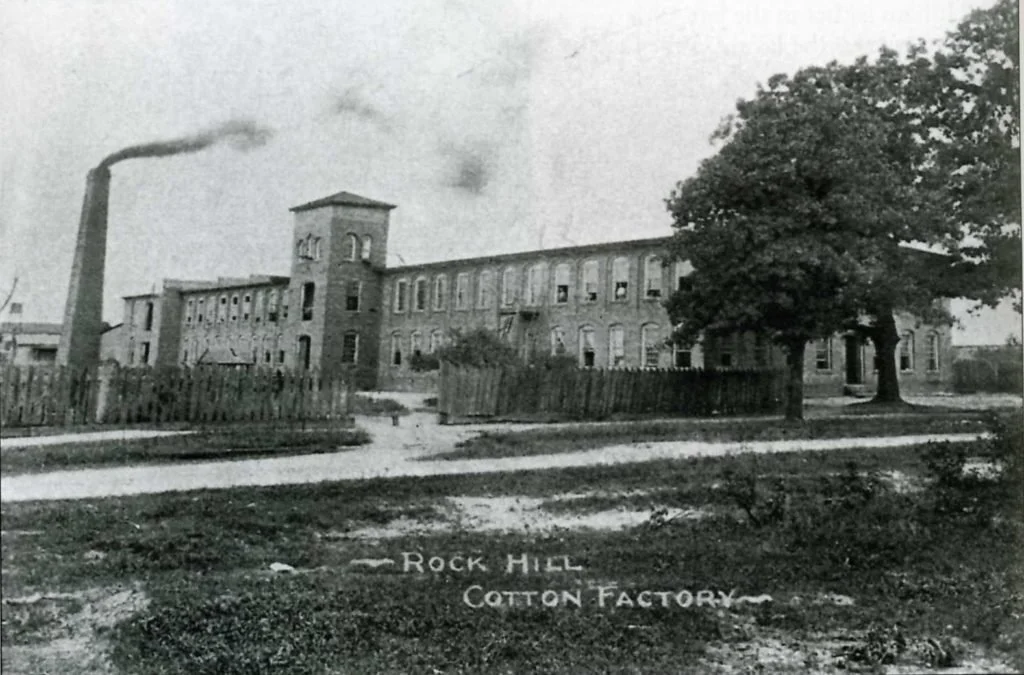
The mill opened with 100 workers (most of them women and children) running a single shift of 60 to 66 hours a week. Unskilled laborers earned 75 cents to a dollar a day. The factory produced yarn exclusively at first, running 7,904 spindles out of a two-story brick structure with a 200-horsepower steam engine at its core.
A pair of water tanks on the roof and an elevated tank beside the boiler supplied the entire operation, fed by a well on the property. That well served the factory for nearly two decades before the building connected to city water.
By 1894, the owners added 196 looms. By 1895, the mill was valued at $175,000, consuming 2,500 bales of cotton a year and producing 12,000 pounds of yarn per week alongside shirtings, sheetings, drills, and cotton rope. The bulk of it shipped north to Baltimore and Philadelphia.
That success spread fast. The Standard Cotton Mill opened in 1889, the Globe Mill in 1890, the Arcade Mill in 1896, and many of them were backed by Cotton Factory investors. Mills began appearing in York, Clover, and Fort Mill. Rural families moved to the mill villages looking for work. The old mill had built this city in a real and measurable way.
The Rock Hill Cotton Factory
1898 · Transition
William Campbell Hutchison took over from his father, briefly renamed the factory Belvedere Mills, and the community kept calling it "the old mill" , a name that stuck for decades (regardless of who owned it).
In 1900, a new ownership group that included Samuel Friedheim of Rock Hill reorganized the operation as Crescent Cotton Mill. The building gained electric lighting powered by Rock Hill's steam-powered generating station, and an overhead sprinkler system for fire control. The on-site well was retired and the factory connected to city water. By this point, 210 looms were running, producing 5,000 yards of cloth per day.
By August 1904, Friedheim and his partners had sold to Southern Textile Company, a New York conglomerate. It declared bankruptcy within a year and the mill went back up for sale.
Belvedere Mills & Crescent Cotton Mill
In July 1905, Detroit textile magnate Hamilton Carhartt purchased the mill. He was already the world's largest manufacturer of work gloves and overalls, and Rock Hill gave him room to grow.
Carhartt converted the factory from steam to electrical power, tapping into the newly completed Catawba Power Company dam at India Hook. Between 1907 and 1909, he added a three-story annex and a dyeing room to the original structure. In 1909, the mill began producing denim, and within a few years, Carhartt denim overalls made in Rock Hill were known around the world.
The annex Carhartt built in 1905 still stands today. It's where the ChristmasVille Santa is lit up each December, bringing all the holiday cheer to the heart of Old Town Rock Hill.
Carhartt's operation thrived through World War I. Then the postwar recession hit hard and the mill closed in 1921. It sat idle for four years.
Hamilton Carhartt Cotton Mill No. 1
1905 · Carhartt Era
1925 · Mid-Century
In 1925, John H. Cutter of Charlotte purchased the building and reopened it as Cutter Manufacturing Company, producing denim and ticking (a strong cotton fabric used for mattress and pillow coverings). The factory supplied fabric for U.S. military uniforms during World War II.
In September 1946, M.C. Goldberg of Charlotte bought the plant and ran it as Gold-Tex Fabrics for over twenty years. Gold-Tex closed in 1967 and the building once again sat empty.
Cutter Manufacturing & Gold-Tex Fabrics
1968 · Late Century
Ostrow Textile Company of New York purchased the building in 1968 but never used it for manufacturing. Part of the complex became warehouse space for towels, sheets, and blankets. Another portion became Plej's Textile Mill Outlet, a retail store that operated until Ostrow closed the facility in 2001.
The Rock Hill Economic Development Corporation acquired the property that same year and held it until 2006.
Ostrow Textile Company
2006 · Renovation
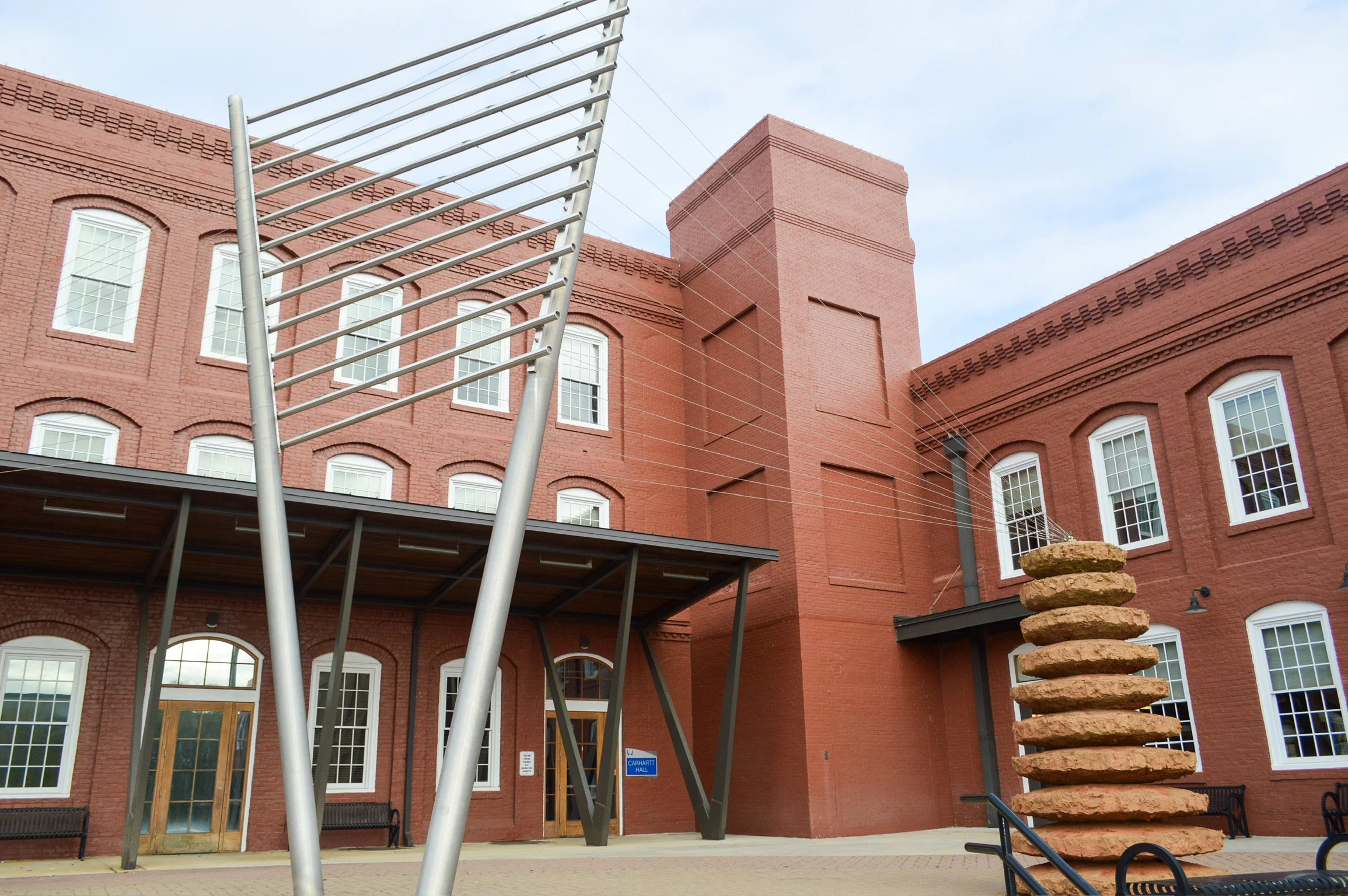
In 2006, The Old Cotton Factory LLC (a partnership of Gary Williams, Bryan Barwick, and Bob Perrin) purchased the building and undertook a $12 million renovation. The exposed brick, heavy timber beams, and arched windows that defined the mill's character were preserved and made central to the new design.
Williams & Fudge, a Rock Hill accounts receivable firm, became the tenant, taking the second and third floors for 220 employees. They created a mini-museum inside their offices honoring Rock Hill's history and the region's textile industry.
On September 6, 2007, the City of Rock Hill and the Culture & Heritage Museums officially dedicated a South Carolina historical marker on the property. One hundred and twenty-six years after the first spindles turned, the old mill was back.
In 2018, Gary Williams and Bob Perrin bought out their partner's interest and continued developing the future of The Cotton Factory.
The Old Cotton Factory, LLC
2025 · Present
In 2025, Chad Echols and David Williams purchased the building (Keeping Williams & Fudge in place) and launched Cotton Factory HQ to create a reimagined space for retailers, makers, and businesses who want something the new construction across town can't offer.
The bones are still original and around every corner you can admire the brick, beams, the arched windows, and in some spaces, even the original hardwood floors. Truly, what's changed is the direction. Cotton Factory HQ is now home to an intentional mix of local entrepreneurs, creative studios, and established Rock Hill businesses building something worth showing up for.
It sits in the heart of Old Town Rock Hill, two minutes from Main Street, less than five minutes from I-77, and surrounded by the restaurants, breweries, and community that make this part of the city worth being in.
Same building, new experience. We’re excited to continue building a legacy here at Cotton Factory HQ.
Cotton Factory HQ
Why Historic Space Matters
New construction can replicate the look of exposed brick and timber beams. It cannot replicate 140 years of presence in a city. The Cotton Factory has been part of Rock Hill's identity since before the city was incorporated. That permanence is something you carry with you when your business moves in.
Clients notice it. Employees talk about it. And when your business occupies a place with that kind of history, that story becomes part of what you're building